 Beelog Tech
Infrastructure monitoring
Railway weather and flood monitoring stations
9+ autonomous stations along 1,000 km of railway measure dangerous weather continuously and alert duty staff in under 2 minutes.
- 9+
- monitoring stations
- 99.5%
- railway-station uptime
- <2
- minutes to alert delivery
Context
Mongolia's railway runs for roughly 1,000 km through sparsely populated country with an extreme climate. Strong wind, flash floods, and sudden cold snaps affect the safety of train operations directly, yet real-time measurement along the line was scarce. In 2019, Beelog Tech took on the railway weather-station contract.
The problem
Without real-time measurements along the line, the operator made decisions from distant forecasts and phoned-in reports. When a dangerous condition goes unnoticed, both safety and the timetable suffer. The stations had to run unattended year-round at remote sites with no grid power and unreliable network coverage.
What we built
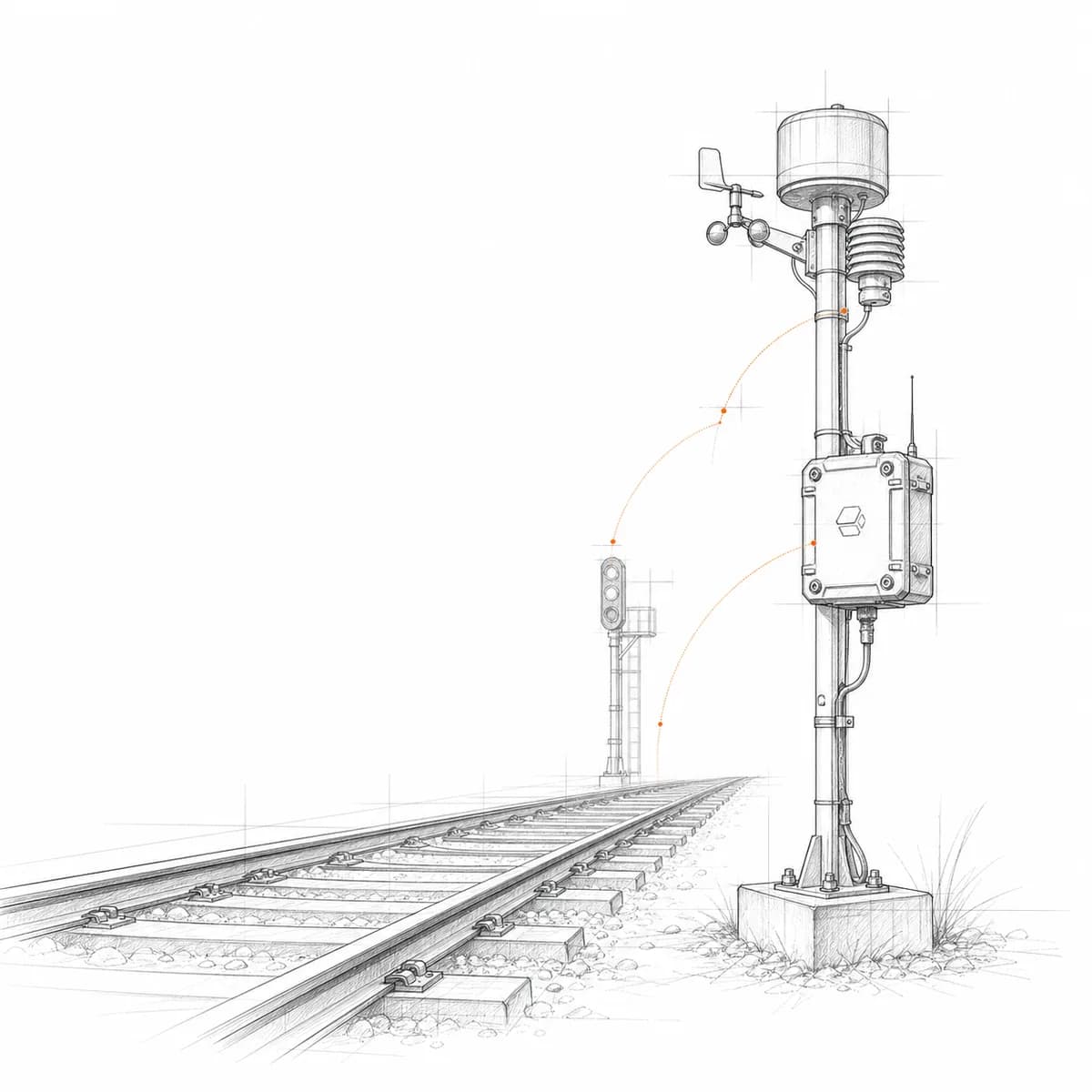
We developed autonomous stations with solar power sized for December sun, batteries that charge below zero, and lightning protection as standard. Data flows over cellular to the Beelog telemetry platform (tz.beelog.tech), where 75 alarm rules combine thresholds with STUCK/SPIKE/DROP anomaly detectors. Alerts go straight to the rail operator by SMS and to the duty channel on Telegram. Each station buffers 30 days of data locally, so outages leave no gap.
Where it runs
9+ stations are installed along 1,000 km of track and have kept working at −40°C. Beelog Tech handles installation, configuration, remote diagnostics, and updates end to end.
What changed
Duty staff now learn of a dangerous condition in under 2 minutes of it developing, so decisions rest on measurements instead of guesswork. The system has run at 99.5% uptime since 2019 and has become a daily safety tool for rail operations.
Built with
Have a site nobody can reach in winter?
Tell us where it is and what has to be measured. Our stations have run at −40°C since 2019.